

Ductless Copper Range Hood Option
A ductless copper range hood option gives homeowners more flexibility when exterior ducting is difficult, unavailable, or visually disruptive to the kitchen design. Instead of sending air outdoors through ductwork, a ductless or recirculating hood filters cooking air and returns it to the room. At MyCustomCopper, the custom copper range hoods collection includes wall-mount, island, and under-cabinet designs in hammered or smooth copper, with standard and custom sizes, patina choices, insert planning, and ducting options. For apartments, condominiums, remodels, and kitchens without a practical exterior route, a ductless copper hood can bring handcrafted style and functional air filtration without forcing the design around existing ducts.
Post Summary
- Understand ductless hoods
- Plan recirculating airflow
- Choose wall or island style
- Confirm insert requirements
- Select copper patina and size

This lifestyle image shows a copper range hood above a large cooking area in a traditional kitchen. The wood cabinetry, tile backsplash, green stone counters, stainless range, copper cookware, and terracotta floor show how a ductless copper hood can still become the main architectural feature.
What Is a Ductless Copper Range Hood?
A ductless copper range hood is a decorative copper hood shell prepared with a recirculating ventilation setup. Instead of connecting to exterior ductwork, the system pulls air through filters and returns that filtered air back into the kitchen.
This makes ductless ventilation useful when exterior venting is not possible. Condominiums, apartments, historic homes, interior kitchen walls, and remodels often create situations where a duct route would be expensive, unattractive, or structurally difficult.
Recirculating Instead of Exhausting Outside
A ducted hood sends air outdoors. A ductless hood filters air and returns it indoors. The difference affects airflow expectations, filter maintenance, installation planning, and cooking performance.
Ductless systems are more flexible, but they depend heavily on the correct insert, filter access, regular filter cleaning, and realistic cooking expectations.
Why Choose a Ductless Copper Hood?
The original post explains the main advantage clearly: a ductless hood does not need to be installed only where there is a pipe or duct to the exterior. This opens more design possibilities.
A homeowner may want the range centered on a wall, under a decorative tile panel, below a beam, or on an island where exterior ducting would be difficult. A recirculating hood can make those layouts easier to consider.
Design Freedom for Remodels
In a remodel, the best visual location for the stove is not always the easiest mechanical location. Ductless ventilation can help when the kitchen design should not be controlled entirely by an existing duct route.
For wall-mounted planning, the article on wall copper kitchen hoods explains how a copper hood can define the cooking wall and become the main feature above the range.
Best Kitchens for Ductless Copper Hoods
Ductless copper hoods are often considered for condominiums, apartments, average-size homes, historic houses, and remodels where adding ductwork would require major construction.
They can also be useful when the kitchen owner wants to avoid visible duct pipes, soffits, or ceiling penetrations that would interrupt the finished design.
When Ductless Makes Sense
A ductless option makes sense when exterior ducting is not allowed, not practical, or not desirable. It can also work when the buyer values design flexibility and moderate filtration more than high-capacity exhaust.
A ventilation professional should still review the cooking appliance, cooking habits, room size, filter type, and local requirements before installation.
Ductless vs Ducted Copper Range Hoods
A ducted copper range hood is usually preferred when the kitchen can support an efficient exterior route. It removes air from the kitchen and sends it outside through ductwork.
A ductless copper hood keeps the air inside the kitchen after filtration. It is easier to place in more locations, but it cannot perform exactly like a properly designed exterior exhaust system.
Choosing the Right Ventilation Approach
Choose ducted ventilation when the home can support a clean exterior route, proper duct diameter, and efficient termination. Choose ductless ventilation when exterior venting is not practical and the kitchen needs a recirculating solution.
The post on a custom copper hood with insert explains why the visible copper shell and the mechanical insert must be planned together before installation.
Insert Planning for Ductless Copper Hoods
The copper hood shell provides the exterior shape, patina, texture, and architectural presence. The insert provides the actual air movement, filters, lights, controls, and service access.
For ductless use, the insert must support recirculation. Filter access is especially important because ductless systems rely on filters to return cleaner air into the room.
Included 200 CFM Insert
A standard copper range hood configuration may include an economy 200 CFM insert. For ductless preparation, confirm before production that the hood should be configured for recirculating air rather than exterior ducting.
The insert, filter access, side openings, controls, lighting, and service points should all be reviewed before the hood is fabricated.
What to Confirm Before Production
Before production, confirm the hood width, height, depth, mounting type, finished ceiling height, cabinet spacing, range width, backsplash thickness, and whether the hood will be wall-mounted or island-mounted.
For ventilation, confirm whether the hood will use the included economy insert or a buyer-supplied system. A recirculating configuration must be planned early because the shell opening and interior preparation depend on the ventilation setup.
Important Ventilation Details
Provide the insert manufacturer, model, specification sheet, overall dimensions, cutout dimensions, duct or recirculating requirements, controls, lighting, filter access, electrical access, and service clearances.
For ducted custom systems, buyer-supplied internal inserts may be reviewed up to 1200 CFM and external systems up to 1500 CFM. For ductless use, confirm recirculating compatibility before ordering equipment.
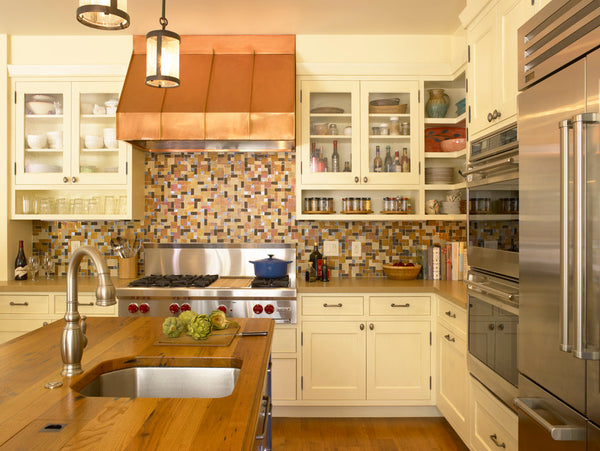
This lifestyle image shows a copper hood in a bright kitchen with cream cabinets, mosaic tile, stainless appliances, a wood island, and pendant lights. The setting demonstrates why a ductless copper hood can be useful when the cooking area needs visual impact without relying on exposed ductwork.
Wall-Mount Ductless Copper Range Hoods
A wall-mount ductless copper hood is installed above a range or cooktop against the main kitchen wall. This is one of the most common applications because the hood can frame the backsplash and center the cooking area.
Without exterior ductwork, the wall hood can sometimes be placed where the design looks best, provided the insert, filters, electrical access, and clearances are correct.
Cooking Wall Design
A wall hood should align with the range, cabinets, backsplash, windows, shelves, beams, and ceiling details. Even when the hood is ductless, visual centering still matters.
For a strong wall-mounted example, the Spanish Revival hammered copper kitchen range hood offers wall or island construction, 30, 36, 48, or 60-inch widths, 24, 36, 48, or 60-inch heights, natural or coffee patina, and an included 200 CFM insert.
Island Ductless Copper Range Hoods
Island hoods are usually more complex than wall hoods because they are visible from multiple directions and require ceiling support. A ductless island copper hood must still be structurally secure and visually balanced.
The recirculating setup may reduce the need for an exterior duct route, but it does not remove the need for electrical planning, filter access, proper mounting, and professional installation.
Island Hood Considerations
An island hood should be centered over the cooktop and aligned with ceiling framing. The chimney, top structure, lighting, filter access, and control placement should be reviewed before production.
Because island hoods are seen from several angles, finish quality, proportions, patina, and side detailing become especially important.
Choosing the Right Hood Size
The hood should be selected around the range width, cabinet opening, ceiling height, and visual scale of the kitchen. A hood that is too small can look weak, while an oversized hood can overwhelm nearby cabinets.
The current range hood collection includes standard widths of 30, 36, 48, and 60 inches, with custom sizing available when the kitchen requires different proportions.
Capture Area and Proportion
When possible, the hood width should exceed the cooking surface by several inches to improve capture and create a stronger visual frame. Depth should also be coordinated with the range and insert.
For broader size and style planning, the article on customizing a copper range hood explains how dimensions, mount type, finish, patina, texture, and insert compatibility shape the final result.
Patina Choices for Ductless Copper Hoods
Patina determines how the hood relates to the rest of the kitchen. Natural copper feels brighter and more lively. Coffee patina creates a deeper brown tone with stronger contrast along edges, curves, straps, and hammer marks.
A darker hood can create a dramatic focal point against white cabinets or pale tile. A natural copper hood can warm darker cabinetry, plaster walls, stone backsplashes, or rustic wood.
Living Copper Finish
Copper is a living material. Heat, humidity, cooking oils, sunlight, handling, and cleaning habits can influence how the patina develops over time.
This natural movement is part of the appeal. It helps the hood gain depth and makes each handmade piece feel authentic.
Hammered and Smooth Copper Options
Texture changes the personality of a ductless copper hood. Hammered copper feels rustic, tactile, and visibly handmade. Smooth copper feels cleaner, more architectural, and more restrained.
A ductless configuration does not limit the exterior style. The hood can still be rustic, Spanish Revival, Hacienda, Tuscan, farmhouse, transitional, minimalist, or Mediterranean depending on the chosen shape and finish.
Choosing Texture by Kitchen Style
Choose hammered copper for old-world, rustic, Hacienda, Mission, Southwestern, or farmhouse kitchens. Choose smooth copper for cleaner transitional spaces, modern kitchens, or rooms with already busy tile or stone.
The smooth bell-shaped custom copper range hood shows how a seamless body, flared crown, medium-brown patina, and wall or island configuration can create a refined copper focal point.

This lifestyle image shows a smooth bell-shaped copper range hood in a transitional kitchen. The white cabinets, subway tile backsplash, pendant lights, stainless range, and medium-brown patina show how copper can warm a clean kitchen without heavy ornament.
Decorative Details for Ductless Copper Hoods
A ductless copper hood can still include decorative straps, rivets, crown molding, apron bands, flared canopies, smooth curves, or hammered surfaces. The recirculating function is inside the shell; the outside can remain fully customized.
Decorative details should be chosen with the cabinetry, backsplash, ceiling height, range width, and kitchen style in mind. Strong details work best when the surrounding room gives them enough visual space.
Hacienda and Riveted Designs
The hammered Hacienda copper range hood with rivets and straps includes hand-hammered copper, vertical straps, large rivets, a bell-shaped body, natural or coffee patina, wall or island construction, and an included economy 200 CFM insert.
This style works especially well in kitchens with wood, plaster, handmade tile, stone counters, wrought iron, terracotta floors, and exposed beams.
Filter Access and Maintenance
Filter access is critical for ductless hoods. Since recirculating systems return air to the room, filters must remain accessible for cleaning or replacement.
Before approving production, confirm how filters are removed, where controls are located, how lights are serviced, and whether the insert can be accessed without damaging the hood or surrounding cabinetry.
Maintenance Planning
A ductless hood should not be designed only for appearance. The insert, filters, lights, controls, and electrical components must remain serviceable after installation.
If access is difficult, routine cleaning can become frustrating, and long-term performance may suffer.
Performance Expectations
A ductless copper range hood can improve comfort by filtering and recirculating air, but it should not be treated as identical to a properly designed exterior exhaust system.
Heavy cooking, high-output burners, frequent frying, long cooking sessions, and strong odors may require more ventilation planning. In those cases, ducted ventilation may be more appropriate if the home can support it.
Match the Hood to Cooking Habits
A ductless hood is often best for moderate everyday cooking, kitchens without exterior ducting, and layouts where design flexibility matters. The selected insert and filters should match the cooking style as closely as possible.
A ventilation professional can help confirm whether recirculating ventilation is suitable for the appliance, room size, and local installation conditions.
Installation Considerations
A ductless copper hood still needs professional installation. The installer must account for structural support, electrical wiring, clearances above the cooking surface, insert access, and secure mounting.
Because air returns to the room, the hood may also need side or upper openings, depending on the selected insert and shell design. These details should be confirmed before fabrication.
Measurements Before Production
Confirm range width, hood width, hood height, finished depth, ceiling height, cabinet spacing, backsplash thickness, installation clearance, electrical location, insert model, filter access, and desired recirculating outlet position.
Accurate measurements reduce the risk of field changes and help the hood arrive ready for the intended installation.
Care and Copper Maintenance
Clean the copper surface with mild soap, warm water, and a soft cloth. Dry the hood after cleaning to reduce spotting and preserve a more even appearance.
Avoid abrasive pads, bleach, ammonia, harsh acids, aggressive degreasers, and metal polish. These products can scratch the surface, disturb the patina, or damage the finish.
Care for the Hood and Insert
The copper shell and the insert require different care. Wipe the copper gently, then maintain filters, lights, fan components, and controls according to the insert manufacturer’s instructions.
For ductless systems, filter maintenance is especially important because the system depends on filtration before returning air to the kitchen.
Ordering a Ductless Copper Range Hood
A successful ductless order begins with clear project information. Decide whether the hood should be wall-mount, island, under-cabinet, hammered, smooth, natural, coffee, standard size, or custom size.
Then confirm the recirculating insert, filter access, electrical location, side or upper return-air openings, installation clearances, and surrounding cabinet or ceiling conditions.
Final Details to Confirm
Before production, confirm the hood dimensions, patina, mounting type, recirculating configuration, insert model, filter access, control location, lighting access, and whether the kitchen has any special installation restrictions.
For custom sizing, ductless preparation, finish guidance, or insert planning, use the custom copper contact form to request help before production begins.
Conclusion: Ductless Copper Hoods Add Flexibility
A ductless copper range hood can be a practical solution when exterior ducting is not available or not desirable. It gives the kitchen more placement flexibility while still allowing the hood to become a warm handmade focal point.
The most important decisions are mount type, hood size, insert compatibility, filter access, recirculating outlet location, patina, texture, installation clearance, and long-term maintenance.
Choosing the Right Ductless Copper Hood
The right ductless copper range hood should fit the range, support recirculating filtration, remain serviceable, and coordinate with the kitchen’s materials. To explore more handmade copper hoods, sinks, tubs, tables, and custom metalwork, visit MyCustomCopper.
1 comment
Hi, I’m interested in a copper ductless wall hood range. Measurements would be 30" wide by 6" high. Would your design include everything including fan, lights, etc? Some detail in the design please.
Thank you,
Carlo